Forgetting and spaced repetition
We forget quickly, but predictably. Spacing out reviews is one of the best-established techniques.
ObjectiveExplain the forgetting curve and the spacing effect, then plan spaced reviews.
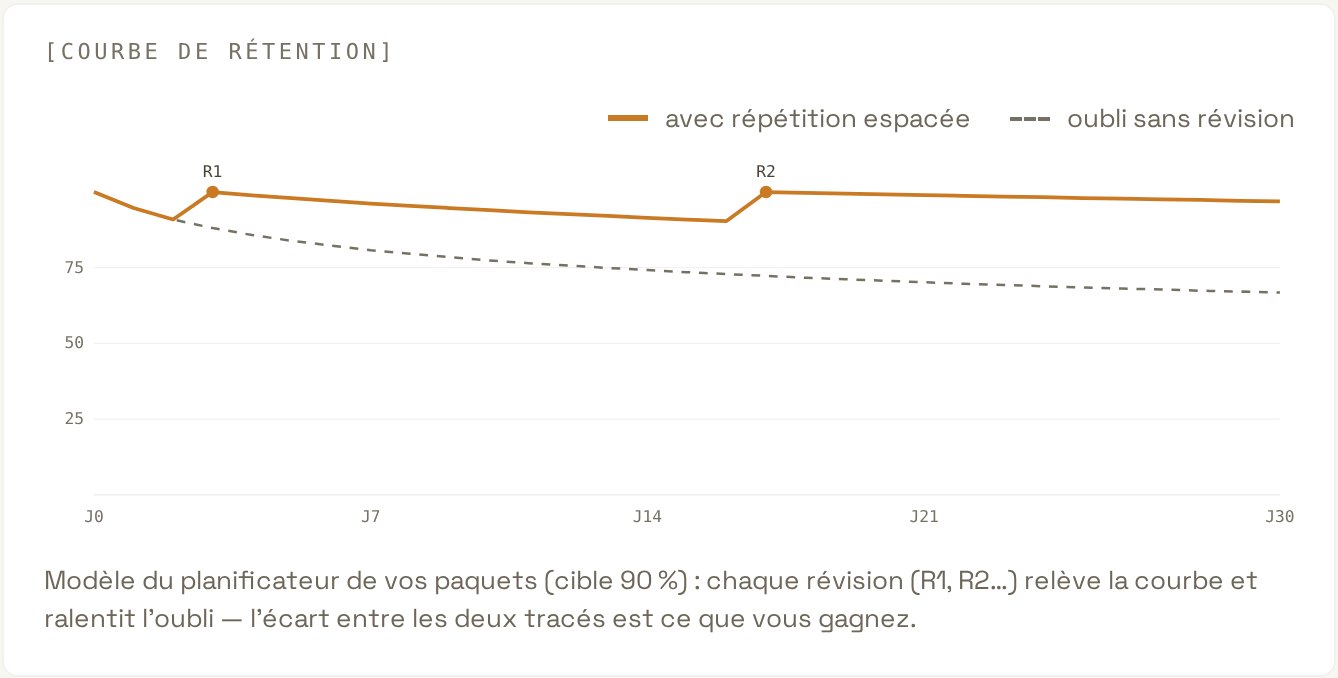
In 1885, Hermann Ebbinghaus measured on himself how quickly he forgot nonsense syllables. He described a curve: forgetting is rapid in the hours that follow, then slows down. Each review lifts the curve and flattens it.
More than a century of research has confirmed the spacing effect. A 2006 review covering hundreds of experiments shows that, for the same study time, spreading reviews over time gives better retention than concentrating them, and that the ideal gap grows with how long you want to remember.
In a course
- Plan short recalls after one day, one week and one month rather than one long review the day before.
- Mix older concepts in with new ones in the exercises.
- Let the tool calculate the due dates. This is what Learnya’s spaced review does for each card.
References
- Ebbinghaus (1885). Ueber das Gedächtnis: Untersuchungen zur experimentellen Psychologie. Leipzig, Duncker & Humblot. English translation: Memory, Teachers College, Columbia University, 1913. catalogue.bnf.fr/ark:/12148/cb30393051c
- Cepeda, Pashler, Vul et al. (2006). Distributed practice in verbal recall tasks: A review and quantitative synthesis. Psychological Bulletin 132(3), p. 354–380. doi.org/10.1037/0033-2909.132.3.354